
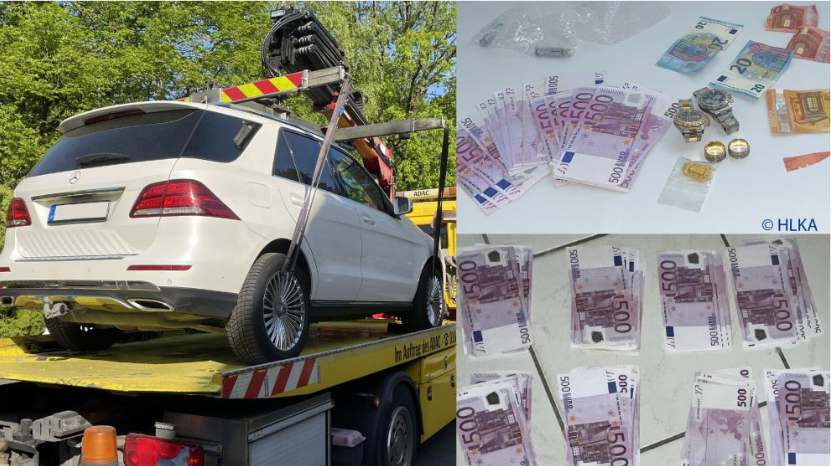
In airports across Europe, customs officers are increasingly stopping travelers carrying large amounts of cash. Sometimes it is €20,000 hidden in luggage. Sometimes hundreds of thousands wrapped in plastic or concealed inside electronics. But according to European investigators, the real concern is often not how much money is being moved — it is where the money came from, where it is going, and how it got there.
This is why European authorities are now focusing more heavily on money routes, informal transfer systems like Hawala, and networks of cash couriers rather than simply the value of the cash itself.
The Rise of Cash Couriers
A “cash courier” is someone who physically transports money across borders. While carrying cash is not illegal by itself, it becomes suspicious when large sums move through complicated routes without clear explanation.
In recent years, European financial crime units have increased monitoring at airports, train stations, and border crossings. Investigators say cash movement is often linked to:
- Tax evasion
- Organized crime
- Sanctions circumvention
- Underground banking systems
- Unreported business transactions
Authorities are particularly interested in patterns: repeated trips, unusual travel routes, and connections between different couriers.
Hawala: The Invisible Banking Network
One of the systems attracting the most attention is Hawala — an informal money transfer method that operates outside traditional banking channels.
Unlike normal bank transfers, Hawala relies heavily on trust and personal networks. A person gives money to a broker in one country, and another broker pays the equivalent amount to someone else in another country. Often, no physical money crosses borders at all.
The system has existed for centuries and is widely used in parts of the Middle East, South Asia, and Africa because it is fast, inexpensive, and accessible.
However, European regulators warn that Hawala can also make financial flows difficult to trace.
Why Europe Focuses on the “Trail”
Financial investigators increasingly say that the amount of money is only one piece of the puzzle.
A person carrying €5,000 may attract more attention than someone carrying €50,000 — depending on the route, contacts, communication records, and transaction history.
This is because modern anti-money laundering systems are designed to identify behavioral patterns:
- Frequent cross-border movement
- Connections between unrelated businesses
- Third-party transfers
- Unusual cash deposits
- Informal settlement structures
Experts note that illegal financial networks often divide money into smaller amounts specifically to avoid attention.
As a result, investigators now prioritize mapping networks and identifying financial relationships rather than focusing only on large seizures.
Europe’s Expanding AML Strategy
The European Union has spent the last several years strengthening anti-money laundering (AML) rules.
New EU frameworks are increasing pressure on:
- Banks and fintech companies
- Crypto platforms
- Payment service providers
- Cross-border money transfer systems
European regulators are also developing stronger coordination between member states and expanding monitoring of suspicious financial activity.
The broader goal is to make hidden financial routes more visible — especially those operating partially outside the formal banking system.
The Human Side of Informal Transfers
Despite concerns, experts also warn against treating every informal transfer system as criminal.
For many migrant workers and families, Hawala remains one of the fastest and cheapest ways to send money internationally, especially in regions with weak banking infrastructure.
This creates a difficult balance for regulators:
- Preventing criminal abuse
- While not blocking legitimate remittances and financial access
That tension remains one of the biggest challenges in Europe’s financial oversight efforts.
A Shift From “Cash” to “Context”
Ultimately, European investigators are changing the way financial crime is approached.
Ten years ago, the discovery of large amounts of cash was often the main trigger for investigations. Today, authorities increasingly focus on context:
- Who moved the money
- How often
- Through which countries
- Using which intermediaries
- And for what purpose
In other words, Europe is no longer just following the money.
It is following the trail behind it.
Sources:
- European Banking Authority AML/CFT framework
- IMF analysis of Hawala systems
- UK Parliament report on Hawala and money laundering
- Voxeurop investigation into Hawala networks in Europe
- European Commission AML reform overview